
Which photos should you use for a hotel or guest house listing?
A useful gallery shows what guests will actually book: the room, beds, bathroom, shared areas, services and surroundings.
- Free registration
- No subscription
- Free help to publish your first listing Get free help
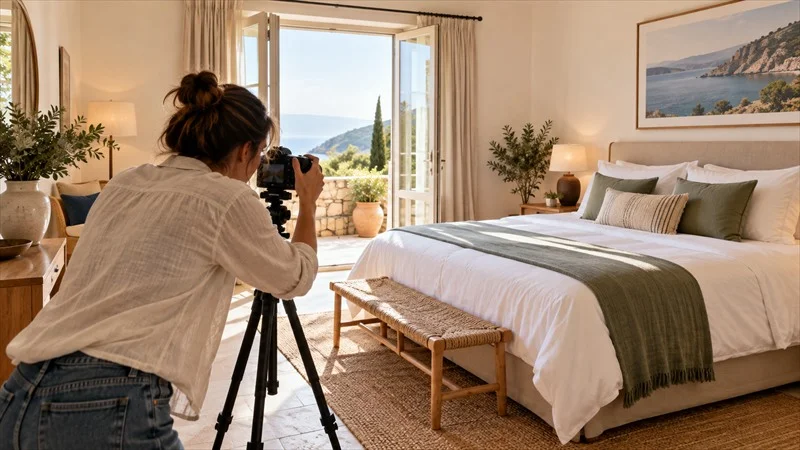
Photographs let travellers decide within seconds whether accommodation matches their needs. A strong gallery is not the one with the largest number of images. It presents every important space in a logical order, with truthful light and without hiding the real proportions.
Choose a first image that is immediately clear
The lead photograph should show what is being booked rather than a decorative detail. For a room, use a view wide enough to understand the bed, available space and atmosphere. For an apartment or house, choose the most representative main room. An exterior view can help, but it should not replace the accommodation itself.
Build a gallery that answers questions
After the lead image, show spaces in the order guests are likely to discover them. A complete set may include:
- the bedroom or main room from two genuinely different angles;
- beds prepared as they will be for the stay;
- the bathroom and, where useful, the toilet;
- the kitchen or dining area when provided;
- any advertised view, balcony, terrace or garden;
- shared spaces that guests may use;
- the entrance, reception or an exterior landmark that helps on arrival.
If your property offers several room categories, keep their photographs separate. Each accommodation type should show what the traveller receives when selecting it.
Use natural light and preserve reality
Tidy the space, open curtains and photograph it under even light. Keep vertical lines as straight as possible and avoid extreme wide-angle lenses that make rooms look larger. A modest brightness adjustment can help; major changes to colours or proportions create expectations the stay cannot meet.
Google similarly recommends focused, well-lit images without excessive alterations when presenting a business. The same approach protects trust in a booking listing.
Photograph details that serve a purpose
A close-up is useful when it answers a question: a workable desk, baby equipment, accessible facilities, a safe, coffee machine or storage. Flowers, cushions and ornaments should not displace essential information.
Avoid duplicates and text overlays
Several nearly identical images slow the gallery without adding proof. Avoid frames, oversized logos, phone numbers and long phrases on photographs. They become unreadable on mobile and distract from the accommodation.
Review the gallery on a phone
Common problems are easy to spot on a small screen: a distant subject, dark room, poor crop or unclear first image. Open the published page as a traveller and make sure the first five photographs already explain the offer.
Keep the photographs current
Replace images when the décor, beds, bathroom or an important service changes. An old photograph can make an accurate description misleading. Before publishing, ensure that everything shown matches the information in the listing.
The useful gallery in one sentence
Show what is booked first, followed by rooms, useful facilities and surroundings, using recent, sharp and realistic photographs. Travellers should be able to picture the stay without guessing.
Sources and references
You may also like
How to attract international guests to your accommodation
Before booking abroad, travellers need to understand the location, accommodation, price, conditions and arrival process.
Read the guide
How to set accommodation rates for different seasons
Useful pricing starts with a realistic base rate, then adapts to seasons, demand, weekdays and the operational needs of the property.
Read the guide
How can you increase bookings for your hotel or guest house?
A clear listing, reliable availability, and easy-to-understand policies can make a difference. Here are the points to focus on to get more bookings.
Read the guide